

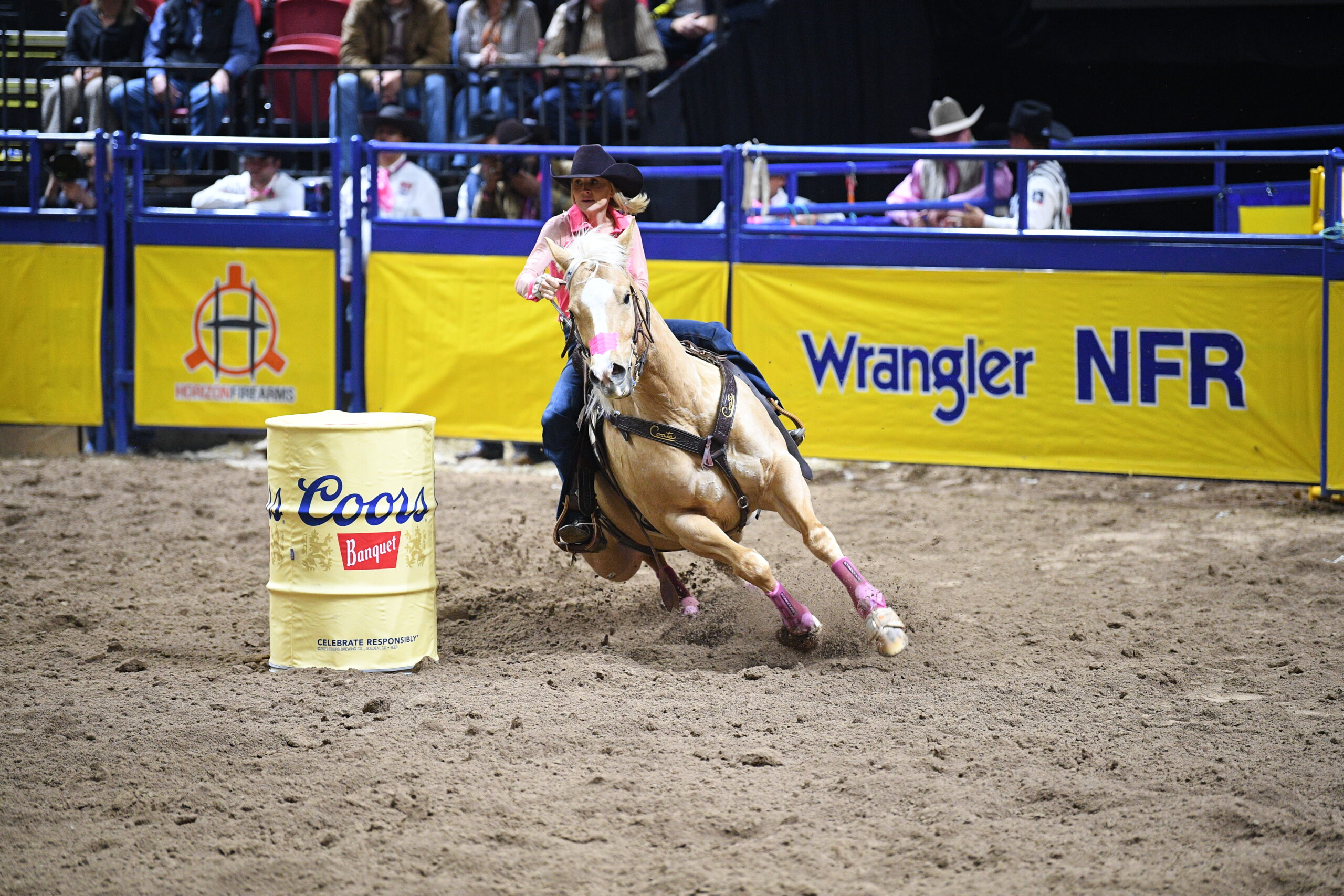
Carlee Otero has won two NFR go-rounds through five runs with $251,829 in season earnings, and her horse AM Regina George is sporting Flair Nasal Strips across the bridge of her nose.
So what exactly are those strips doing for Otero’s horse? Despite fans’ criticism of the strip’s fit, Otero explained that she’s worked with her veterinarian and the Flair team to position the strip just perfectly each night on the petite palomino mare’s nose, bridged just higher than on other horses.
- PROFile: The Carlee Otero Story
- Carlee Otero Takes Two Hit Barrels to Heart, Battles Back to Round 3 NFR Victory
Q: What are FLAIR strips, exactly?
They’re drug-free, adhesive nasal strips with built-in support bars designed to keep the soft tissue over a horse’s nasal passages from collapsing during intense exercise. Horses can’t breathe through their mouths, so whatever they pull through their nose is all they get. FLAIR strips give them a little mechanical support right where the airway wants to pinch shut.
Q: Why does the nasal passage collapse at all?
A horse’s nasal passages are long, narrow and lined with soft tissue. During a big inhale in a run, the pressure inside the airway becomes strongly negative. That sucks the soft tissue inward, narrowing the airway and forcing the horse to work harder for every breath. More resistance means more energy wasted just moving air.
Q: How do FLAIR strips prevent collapse?
The strip’s spring-like plastic supports span the nasal valve area — the narrowest part of the airway. When the horse inhales and the tissue tries to draw in, the strip braces it and keeps the airway open. That reduces inspiratory resistance, lowers the effort needed to pull in air and helps the horse maintain a steady oxygen supply.
Q: What does that mean in real performance terms?
Research shows several measurable benefits when horses compete in FLAIR strips:
• Lower energy cost of breathing. Horses use roughly 5 to 6 percent less energy when the nasal passages are supported.
• Reduced tracheal inspiratory pressure. They don’t have to generate as much negative pressure to inhale, which cuts down respiratory strain.
• More air with less effort. With the airway stabilized, airflow becomes smoother and more efficient.
• Less overall fatigue. When the muscles responsible for breathing aren’t stealing energy from the muscles needed to run, turn or stop, performance lasts longer.
For a barrel horse, that translates to better drive to and through the first barrel, less fade on the backside of a run and a cleaner out of the arena. It’s a small assist that shows up in big moments.
Q: What about recovery? Does the strip help after a run?
Yes. Because the airway stays open during the early stages of cool-down, horses wearing FLAIR strips tend to stabilize their breathing quicker. Faster recovery means lower post-run stress on the cardiovascular system and a better return to baseline before the next draw, especially at multi-round events or jackpots where horses may make repeated runs.
Q: Does it help with bleeding (EIPH)?
That’s one of the most compelling pieces of research. The theory is simple: intense negative pressure during inhalation puts stress on the lung’s tiniest blood vessels. Reducing airway resistance reduces that negative pressure. Several treadmill studies found that horses wearing FLAIR strips had a lower incidence and severity of exercise-induced pulmonary hemorrhage. While nothing eliminates EIPH entirely, external nasal support can lighten the load on the lungs and may reduce the risk.
Q: Is this only for elite competition horses?
No. The company points out the strips help horses in every discipline — and sometimes help the average horse even more. A less-conditioned horse or a green athlete working above its comfort zone can benefit from easier airflow, smoother breathing and reduced respiratory fatigue. Plenty of junior, open and youth riders use the strips for everyday training.
Q: How do you apply them correctly?
Clean, dry skin is mandatory. The strip should sit about 1.5 inches above the nostrils, centered evenly. Press it down firmly for full contact. Most riders apply them 20 to 30 minutes before warming up so the adhesive has time to set. Leave the strip on through the run and the cool-down. When removing, peel from a top corner inward toward the center to avoid pulling hair.
Q: What do riders actually notice?
Feedback is pretty consistent: horses run more freely, don’t “hit a wall” late in a pattern, and stay more even in their breathing. Some riders say their horses seem mentally quieter warming up because they aren’t fighting for air. When seconds and hundredths matter, anything that supports consistent airflow becomes a real competitive tool.
Q: Is there any downside?
Not really, unless someone slaps it on crooked or on dirty skin and it falls off. It’s a low-risk, non-drug piece of equipment backed by actual peer-reviewed studies. The only “con” is remembering to restock your tack room when everyone starts borrowing yours.