

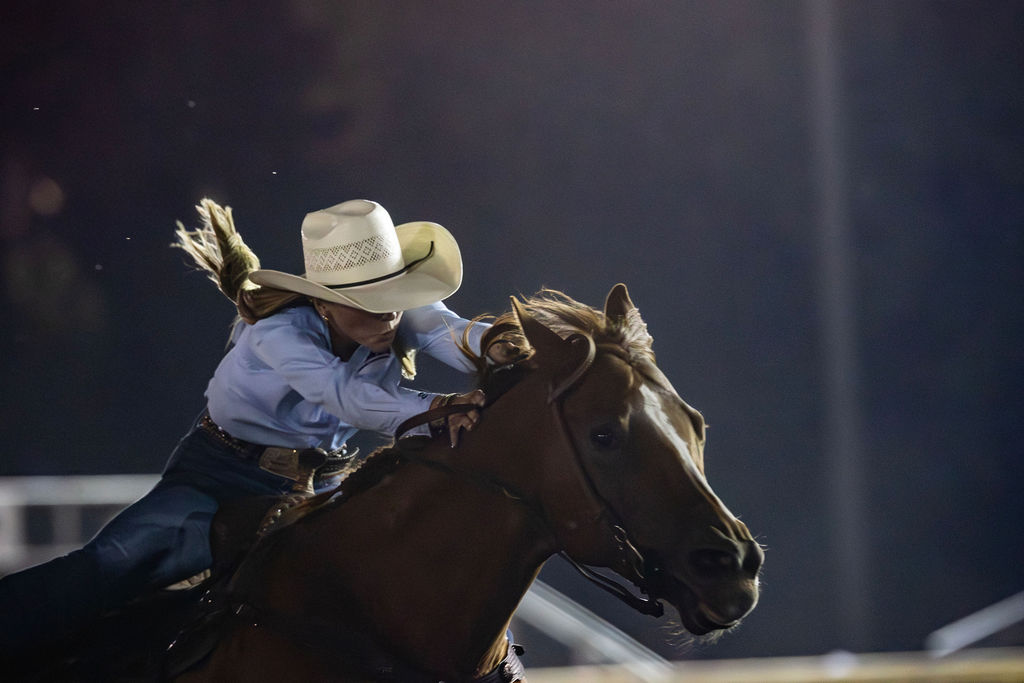
Everything a barrel racer needs to know before buying a WPRA permit, filling it and earning a pro card
A barrel racer who has been running at jackpots and open shows, and who is starting to wonder what it takes to compete at PRCA rodeos, has a clear path in front of her. Turning pro through the Women’s Professional Rodeo Association (WPRA) is not complicated once the whole route is laid out. The trouble is that almost nobody lays it out before a rider is standing at an entry deadline trying to work out what a “member dues date” is, or why her winnings do not seem to be counting.
What follows is the whole thing, start to finish: what to buy, in what order, how a permit gets filled, how to enter that first rodeo and who all these people are on the standings. The quick-start list below is the ninety-second version. The sections after it fill in the detail.
- S1 Ep 33: WPRA 101 with Heidi Uecker-Schmidt
- WPRA Finals Barrel Racing 2025: Draws, Results and How to Watch
- The Complete List of WPRA Resistol Rookie of the Year Barrel Racers
Table of contents
- Quick start: the whole path
- What the WPRA actually is
- The permit, the $1,000 and the card
- The other permit choices
- Rookie status and the Resistol Rookie of the Year
- Every card and membership, and what each one is
- Entering rodeos: the member portal and ProCom
- Getting paid: RodeoPay
- Circuits and circuit representatives
- Two more tracks: the Playoff Series and the WPRA Tour
- Rookie mistakes to sidestep
- Quick reference
Quick start: the whole path
Step 1 The permit. Every barrel racer starts here. A WPRA permit costs $400. Membership requires being 18 and joining with a birth certificate, an application and a signed statement that the rulebook has been read.
Step 2 Filling the permit. The next step is winning $1,000 in WPRA-approved barrel racing, known as filling the permit. The money adds up year to year until it reaches $1,000.
Step 3 The card. Once that $1,000 is won, the full WPRA card is available for $495. That card is the pro card.
Step 4 Circuit designation. Paying dues means designating one of the WPRA’s geographical circuits, usually the one where the rider lives. That circuit is where she chases standings and a circuit finals berth.
Step 5 Entering through the portal. Most entries now start in the WPRA Membership Portal at portal.wpra.com, which hands off to the PRCA entry system, ProCom. Entering by phone at (800) 234-7722 still works. Everything runs on Mountain Time, and dues must be paid a few days before entries open.
Step 6 Getting paid through RodeoPay. An account at rodeopay.com brings winnings back fast instead of by mail.
One timing rule is worth burning into memory: after a permit is filled, the card should be bought before the next entry. In that order, the extra winnings count toward the standings and Rookie of the Year. Enter again first and a rider can leave money and rookie eligibility on the table.
What the WPRA actually is
The WPRA is the oldest women’s sports organization in the country. It started in 1948 when 38 Texas ranch women founded what was then the Girls Rodeo Association, the first professional sports body created for women by women. It became the WPRA in 1981. Today it has more than 3,000 members and sanctions over 1,500 events a year with payouts topping $5 million.
For a barrel racer, the part that matters is this: the WPRA is what sanctions the barrel race at PRCA rodeos. When barrel racing runs at a pro rodeo, that race is governed by WPRA rules and it feeds the WPRA world standings. The association also sanctions breakaway roping and, through its divisional side, roping and jackpot events. Everything is organized under a circuit system, which decides who advances to circuit finals, and the season builds toward the world standings and the sport’s biggest stages.
The permit, the $1,000 and the card
This is the ladder every barrel racer climbs to turn pro. Three rungs: buy a permit, fill it, buy the card. Here is what each one means.
Rung 1: The permit
A permit is the beginner membership. It costs $400 for 2026, and it lets a rider enter WPRA-approved rodeos and start winning money that counts toward turning pro. Joining requires being at least 18, and the WPRA needs three things: a copy of the birth certificate, a completed application and a signed affidavit confirming the rider has read the rulebook and agrees to abide by it. The application lives under the membership and forms pages at wpra.com, and the office at (719) 447-4627 can confirm it was received.
A note on who can join: WPRA membership is open to women 18 and older. The association also runs a Junior Barrel program for younger riders and a youth roping program, but the permit-to-card path in this guide is the adult professional track.
Rung 2: Filling the permit
Filling a permit means winning a cumulative $1,000 at WPRA-approved barrel racing events. A few things about that $1,000 catch people out:
- It adds up over time. Winnings accumulate year to year until they reach $1,000. It does not have to happen in one season.
- The rider tracks it herself. The rulebook puts the responsibility on the member to keep her own records of money won. A running tally is the only way to know when filling is close.
- Futurity and derby money does not count. The $1,000 has to come from WPRA-approved open barrel racing, not futurity or derby events.
- Filling mid-rodeo weekend is fine. Crossing $1,000 partway through a rodeo run is allowed; the rider finishes that rodeo and any already entered without penalty.
- But nothing new gets entered on a filled permit. Trying to enter more WPRA rodeos on a permit that is already full risks a fine and a ruling of ineligibility.
Rung 3: The card
Once the permit is filled, full card membership is available. The card costs $495 for 2026 and it is the pro card. A card member competes for world standings, circuit points and Rookie of the Year, none of which a permit holder can win.
The single most important timing rule in this guide lives right here. Money won as a permit member does not count toward Rookie of the Year or the standings unless the card is bought after the permit is filled and before the rider enters again. In that order, any winnings over the $1,000 carry over to card standings. Enter another rodeo before upgrading and that window closes. A rider filling her permit who intends to chase a rookie title should buy the card the moment she fills, before the next entry.
The other permit choices
Filling a permit does not force an immediate card purchase. On filling, a member has a few options:
- Buy a second permit ($300). This allows competing on a permit for the rest of that year with no dollar limit, and it keeps rookie eligibility intact. A member cannot go past a second permit once the first is filled, unless she qualifies for the college permit below.
- Take a college permit (up to 5 years). A rider enrolled full time, at least 12 credit hours, can apply for an extended college permit and ride on it for up to five years, with a transcript attached to the application. The catch: there is no dollar limit, but no money won on a college permit counts toward WPRA standings, and none of it carries over at the eventual upgrade to a card.
Two more permit realities are worth knowing before a first entry. Rodeos with purses under $3,000 must accept permits, but bigger rodeos decide for themselves whether they will take permit holders, so the listing is worth reading. And permit members may not compete in a PRCA rodeo that has a non-WPRA-approved barrel race.
Rookie status and the Resistol Rookie of the Year
A rider’s rookie year is her first year holding a full card. That status begins only with the card, which is why the timing at the top of this guide matters so much. Money won on a permit does not count toward a rookie title unless the card is bought after the permit is filled and before the next entry.
Rookie of the Year goes to the card member who wins the most money in the Pro Rodeo Rookie Standings during that first card year, and those standings include every official-entry WPRA barrel race at a PRCA rodeo, right down to National Finals Rodeo (NFR) winnings. The award carries a title sponsor, Resistol, so the race is known as the Resistol Rookie of the Year and the running tally is the Resistol Rookie Standings.
There is a circuit version too. Circuit Rookie of the Year goes to the first-year card member who is the high money winner within her circuit as of the circuit finals, so a rookie can chase both a national and a circuit rookie title in the same season.
The Resistol Rookie Roundup
Early each year the rookies get a showcase of their own. The Resistol Rookie Roundup brings the top 10 first-year cardholders from the WPRA and PRCA together for two rounds and an average; the 2026 running was held March 20-21 in Fort Worth. The money won there counts toward the WPRA world standings, and the champion earns a spot in an American Rodeo semifinal, so a strong rookie start can open doors quickly.
Every card and membership, and what each one is
The WPRA sells several kinds of membership. Most barrel racers only ever touch the permit and the card, but the whole menu is worth knowing, especially the letter codes, because those appear next to names in the standings and on entries. Here are the 2026 dues.
| Membership (code) | 2026 fee | Who it is for |
|---|---|---|
| Permit member (R) | $400 | Where every barrel racer starts. Allows entering and winning toward the $1,000. |
| Full Card member (W) | $495 | The pro card, bought after the permit is filled. Competes for world and circuit standings. |
| Upgrade to 2nd permit or Rookie card | $300 | A second permit after filling, or the move onto a rookie card. |
| Pro Rodeo Breakaway card (B) | $495 | For competing in WPRA-sanctioned breakaway roping at pro rodeos. |
| Roping Division card (P or A) | $190 | For the WPRA divisional circuit roping events (breakaway, tie-down, team roping). |
| Gold Card, competing | $285 | For members with 25 straight years of card membership, or 20 years and age 50. Same rights as a card. |
| Gold Card, non-competing | $50 | Inactive gold card. Keeps voting rights but not competing rights. |
| Duplicate card or companion pass | $15 | Replacement fee for another physical card or pass. |
About those letter codes. The prefix in front of a member number signals the kind of membership: W for full card, R for permit, P or A for roping division, B for pro rodeo breakaway and U for cash-only, which appears only on ProCom. They become easy to read at a glance.
The deadlines matter too. The WPRA dues year runs January 1 through December 31, and dues are due by December 31 for the year ahead. A late renewal draws a fine: $25 if it reaches the office between January 1 and February 1, and $50 after February 1. First-time permit holders are exempt from those late fees, so a brand-new rider joining mid-season need not worry about them.
Entering rodeos: the member portal and ProCom
WPRA rodeos do not use a mailed entry form for each event. Entries instead go through a central entry office called ProCom, which handles entries for WPRA and PRCA rodeos. A contestant gives her member number and preferences, and ProCom draws her position. These days that starts in the WPRA Membership Portal far more often than it starts on the phone. This is the part that feels most foreign to new members, so here is how it actually works.
The WPRA Membership Portal
Most of a season now runs through one login. The WPRA Membership Portal at portal.wpra.com is where a member creates an account, signs in and works from a dashboard carrying her notifications, her account balance and her rodeo entries. Setting it up the week the membership is processed is the right move, not the week of a first entry.
Entries start there. The dashboard has a Rodeo Entries panel with an “Enter a Rodeo” link, and choosing it hands the member off to the PRCA entry system, which is ProCom. The portal is the front door rather than a separate entry office, so everything else in this section still applies: the Mountain Time clock, the draw and the call-back, the buddy system, the turnout deadline. Phoning ProCom at (800) 234-7722 still works and is still the fallback when something goes sideways, but the portal is how most riders enter now.
One distinction is worth getting straight before any money moves. Member dues and entry fees are not the same thing, and they are not paid in the same place. Dues, meaning the permit and the card, go to the WPRA national office and have to be processed before entry, which is what the member dues date is about. The portal handles the competition side of the ledger only: entry fees and fines. Its Account Details panel shows unapplied credit and a projected account balance, and a separate panel lists outstanding fines and outstanding fees. A rider who assumes she can renew her card in the portal the night before entries open is going to miss the rodeo.
Before entry: get the dues in early
Membership has to be paid and processed before entry. The rule is that the application and dues must reach the WPRA national office no later than three WPRA business days before entries open, by 5:00 pm Mountain Time, to allow processing. In the rodeo listing this shows as the “member dues date.” Miss it and that rodeo is off the table, so joining or renewing the week entries open is cutting it too close.
Reading a rodeo listing
Rodeos are listed at wpra.com, and the PRCA ProRodeo Business Journal carries entry closing dates as well. The things to hunt for in a listing are the added purse, the date and time entries open and close, the member dues date, the number of go-rounds and performances, and the circuit the rodeo sits in. The added purse matters because it sets the entry fee, which brings up the money.
What it costs to enter
The entry fee is set by a scale based on the rodeo’s added purse, plus a $21 ProCom fee on every entry. Here is the 2026 barrel racing scale.
| Added purse (per event) | Entry fee, 1 go-round | Entry fee, 2 go-rounds |
|---|---|---|
| Up to $999.99 | $50 | $90 |
| $1,000 to $1,999.99 | $55 | $95 |
| $2,000 to $2,999.99 | $65 | $100 |
| $3,000 to $3,999.99 | $70 | $110 |
| $4,000 to $5,999.99 | $90 | $130 |
| $6,000 to $9,999.99 | $110 | $170 |
| $10,000 to $14,999.99 | $135 | $210 |
| $15,000 and over | $210 | $260 |
Add $35 for a rodeo with a finals or short round, and another $50 for every extra full go-round beyond two. The $21 ProCom fee sits on top of all of it. Entry fees are paid to the rodeo secretary at the rodeo, or must reach the WPRA office by 3:00 pm Mountain Time on the Tuesday after the rodeo ends.
The mechanics: numbers, call-backs and turnouts
A handful of ProCom habits keep a contestant out of trouble:
- Everything runs on Mountain Time. Entries, call-backs and closings all follow ProCom’s clock, no matter where the rider or the rodeo is.
- The member number has to be right. No one is entered without a valid, correct number, and the member is responsible for how her number gets used.
- Positions are drawn, then called back. After entries close, positions are drawn and the contestant calls back to learn her run time. Barrel racing has a 1.5-hour grace period after each closing to draw out or change preferences.
- The turnout deadline matters. A turnout must be reported to ProCom no later than three hours before the scheduled performance. If slack runs in the morning before the first performance, the deadline is 5:00 pm Mountain Time the day before.
- Official versus unofficial entries. Unless specified otherwise, every rodeo entered is an “official entry,” and only official entries count for world, circuit and rookie points. There is a cap of 100 official barrel racing entries per year.
- The buddy system. A contestant can ask to be drawn for position with up to three others so they run in the same performance or slack. Preferences have to match exactly for it to hold.
Getting paid: RodeoPay
Winnings do not have to wait on a check in the mail. RodeoPay is the service that moves winnings from WPRA-approved barrel races at PRCA rodeos to the member quickly. An account is set up at rodeopay.com, and a member guide on the WPRA site covers the details. The RodeoPay line is (877) 287-2448. RodeoPay handles receiving winnings, not paying entry fees, which is why it sits separate from ProCom.
Circuits and circuit representatives
The WPRA divides the country into geographical circuits, and understanding them early pays off, because a rider’s circuit is her most realistic path to a finals in those first few years. Chasing the world standings means hauling all over the country. A circuit sits closer to home, with its own year-end standings, its own finals and its own awards.
Picking a circuit
Paying dues means designating a circuit, normally the one where the rider lives. That designation is what creates eligibility for the circuit’s finals. It can be changed during the year only before the rider has entered any WPRA event, so the choice matters at sign-up. There are 12 circuits across the United States, plus the Canadian Maple Leaf Circuit, for 13 in all.
| Circuit (code) | States | 2026 director |
|---|---|---|
| Badlands (X) | North Dakota, South Dakota | Nicole Bice |
| California (S) | California | Sheena Robbins |
| Columbia River (Y) | Oregon, Washington, Idaho north of the Salmon River | Kacey Gartner |
| First Frontier (U) | CT, DE, ME, MD, MA, NH, NJ, NY, PA, RI, VT, VA | Crissy Chromczak |
| Great Lakes (A) | IL, IN, IA, KY, MI, MN, MO, OH, WI | Melora Potter |
| Montana (M) | Montana | Dillon McPherson |
| Mountain States (R) | Colorado, Wyoming | Shelly Vossler |
| Prairie (P) | Kansas, Oklahoma, Nebraska | Cindy Gillespie |
| Southeastern (K) | AL, AR, FL, GA, LA, MS, NC, SC, TN | Ashley Rogers |
| Texas (L) | Texas | Lois Ferguson |
| Turquoise (H) | Arizona, New Mexico | Jenna Duhon |
| Wilderness (W) | Nevada, Idaho south of the Salmon River, Utah | Annie Rose |
The Maple Leaf Circuit (Canada)
The 13th circuit sits north of the border. The Maple Leaf Circuit is the WPRA’s Canadian division, covering approved rodeos in Alberta, British Columbia and a handful of co-approved events in neighboring states. It runs alongside the Canadian Professional Rodeo Association, so entry openings and closings for those CPRA rodeos are posted at rodeocanada.com rather than through ProCom. A member based in Canada designates Maple Leaf the way a rider in the States designates her home circuit, and it carries its own standings and its own circuit finals.
What a circuit director does
Each circuit elects a director, and that director is its representative. She sits on the WPRA board, speaks for the circuit and is the first point of contact for circuit questions, from how many go-rounds a rodeo runs to conflicts and moves to the circuit finals itself. When something about a circuit does not make sense, the director is the person to ask. Current contact information for every director is at wpra.com.
Making a circuit finals
Qualifying for a circuit finals means finishing inside the top group in the circuit standings, which each circuit sets at 10, 12 or 15, and meeting the 40 percent or 15 rule. In plain terms: a rider living in her designated circuit needs to compete in 40 percent of that circuit’s rodeos or 15 of them, whichever is fewer. A rider who designated a circuit she does not live in faces whichever is greater, which is why most people run in the circuit they call home. Rodeos entered on a permit count toward that total if the rider buys her card that same year.
Two more tracks: the Playoff Series and the WPRA Tour
The world standings are not the only race running through a season. Two other tracks sit on top of the regular schedule, and both are worth understanding early, because one of them is among the friendliest doors a newer card holder has.
The Playoff Series
The Playoff Series is a separate points race held at a designated set of the sport’s bigger rodeos, with its own barrel racing and breakaway standings. Points go to the top 20 at each Playoff Series rodeo, scaled to the rodeo’s payout and awarded on placing in the average. A no score or no time earns nothing, and turning out costs up to a 10-point deduction, so the Series rewards showing up and staying consistent at the marquee stops.
The WPRA Tour
The Tour is the more accessible of the two, and for a newer rider it may be the most useful thing in this whole guide. It is a points competition built from 60 selected rodeos, the ones adding $5,000 or less, running October 1 through September 30. A rider’s Tour standing comes from her best 7 results among those events, scored by placing from 15 points for a win down to 1, with no minimum number of rodeos required to take part. The reason it matters: many limited-entry rodeos, the ones a beginner cannot simply enter, use the Tour standings as a way in. Running well on the Tour is a realistic path into rodeos that would otherwise be closed to a newcomer.
Rookie mistakes to sidestep
None of these are complicated, but each one catches new members. This short list is worth keeping somewhere visible in a first season.
- Track permit money. Nobody announces when a rider is one check from filling. A tally prevents surprises.
- Upgrade before entering again. After filling, the card comes before the next entry, or the extra winnings and rookie standing may not count.
- Join early, not at the deadline. Dues have to be in the office three business days before entries open. Late paperwork means no entry.
- Work in Mountain Time. Entry, call-back and turnout deadlines all run on it.
- Read the listing first. Purse size sets the entry fee, and it also decides whether a rodeo accepts permits at all.
- Renew on time. A lapsed membership can forfeit the points, rodeo count and money already won that year.
Quick reference
| WPRA office | (719) 447-4627 · wpra.com |
| ProCom central entry | (800) 234-7722 · local (719) 548-4800 |
| RodeoPay (winnings) | (877) 287-2448 · rodeopay.com |
| Member Portal | portal.wpra.com · entries, entry fees and fines |
| Membership and forms | wpra.com/memberships · wpra.com/forms |
| Permit | $400 · filled by winning $1,000 |
| Full card | $495 · bought after filling, before entering again |
Sourced from the 2026 WPRA Rulebook and wpra.com, current as of July 2026. Fees, deadlines and directors can change from year to year, so the current details are worth confirming with the WPRA office before entering or sending payment.