

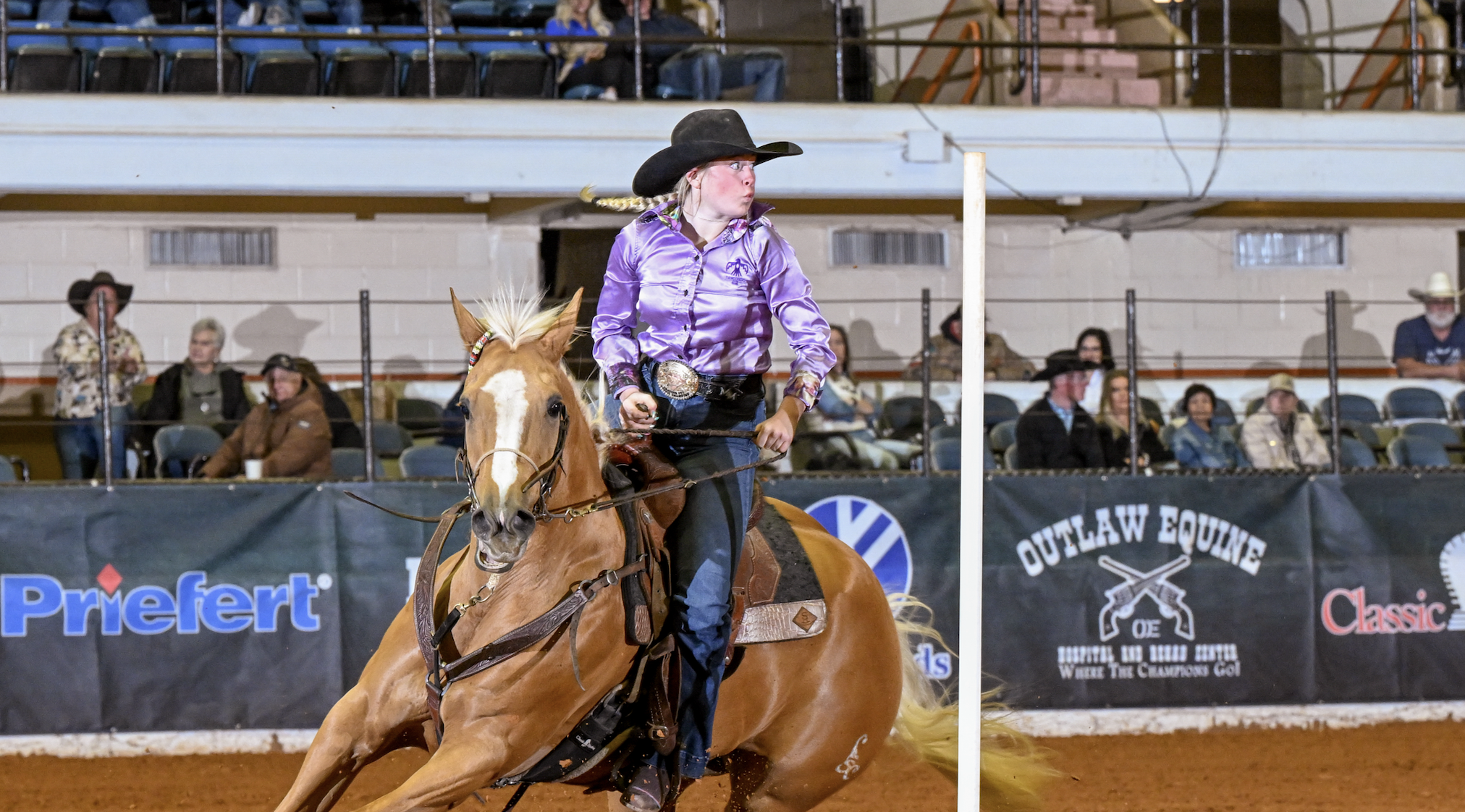
A soon-to-be high school senior with a pro permit on the horizon and a stack of world titles already behind her, Merrick Moyer keeps picking junior rodeos over open incentive money — on purpose.
With the cinch World Championship Junior Rodeo coming up, she explains the math that both parents and youth forget to do.
Given the choice this summer between the $1.3-million Ruby Buckle West — the open incentive race in South Jordan, Utah, that BarrelRacing.com covered just weeks ago — and the youth Best of the Best in Gallup, New Mexico, Merrick Moyer didn’t hesitate.
Although she loves The Buckles events, she took the youth rodeo in Gallup.
“There are only so many years that I can do these events,” Moyer said.
That one sentence is the whole philosophy. Moyer — the reigning Cinch World Championship Junior Rodeo All-Around World Champion and a soon-to-be high school senior — is one of the most accomplished young hands in the country, with the kind of horsepower and results that could send her straight toward open and incentive paydays. Plenty of kids her age chase exactly that.
Moyer is deliberately doing the opposite, spending these last eligible summers in the youth ranks while the window is still open. Next week at the Lazy E, that choice puts her right back where she wants to be: the WCJR.
- Hadlee Landers and Merrick Moyer Earn WCJR Barrel Racing World Titles
- Merrick Moyer Splits Patriot Bonus $100K AGAIN, Comes Away with $40K
- Merrick Moyer and “Hiccup,” Take Home National Junior High Finals Barrel Racing Title
The forgotten math
The temptation to grow up fast has never been stronger in barrel racing.
Incentive programs and open jackpots dangle life-changing money, and a talented teenager can be forgiven for wanting to go get it. Moyer sees it differently. She treats her youth eligibility as a clock, not a paycheck.
“Right now I’m still in high school, so I go to the youth stuff before the open stuff or the incentive races,” she said. “I love the incentive races — but I can do those the rest of my life. I can only do the youth stuff for so long.”
It helps that the trade-off isn’t what it used to be. The youth sector has grown up around athletes like her: the WCJR alone guarantees more than $145,000 in added money, and Moyer left Guthrie last year with a saddle, two Turtle Box speakers and $12,031. “You don’t go to very many youth rodeos that don’t have a lot of money in them anymore,” she said. “Most pay pretty good.” In other words, she isn’t sacrificing much to stay — she’s just refusing to rush.
Friends, fun, and the reasons we compete
Ask Moyer why the youth years are worth protecting and the answer isn’t about buckles at all. It’s about who’s standing at the fence next to her.
“I want to go pro rodeo. I don’t know very many of my friends that do,” she said, “So I like to take those opportunities to hang out with them and do the youth stuff right now.” The open road will always be there. This particular version of it won’t be.
It’s a mindset her family has guarded on purpose. “We try to keep it fun,” her mother, Rickki, has said. “If it’s not fun, you need to look at what you’re doing and adjust. … They get out of the sport what they put into it.”
And the drive, Rickki stresses, has always come from Merrick: “We’ve never made her do it. That’s her.” Keeping the joy in it now is how you make sure there’s still a rider left to turn pro later.
Why the WCJR fits the plan
If Moyer is going to spend a summer in youth rodeo, she wants it to feel like it matters — and the WCJR is her clearest example of the youth game done right.
“They make it a huge event, for us youth people to be able to go on a big platform and be treated kind of like a pro rodeo,” she said. “It’s ran outstanding. The good ground, the prizes, the added money — everything about it. I love that rodeo.”
She points to the format, too: the WCRA points system lets kids nominate runs all season and drop in for the semis or finals, so a busy summer schedule doesn’t cost you a shot at a title.
She’ll bring the two horses who’ve made her to Guthrie. In the barrels it’s “Hiccup,” the 11-year-old grade gelding — unregisterable because his dam was an Appaloosa, but Pink Buckle–eligible through DNA verification to sire MP Jet To The Sun, and raised and trained by Moyer’s mentor Ceri Ward. “It’s hard to run anything else at the Lazy E over Hiccup,” she said. “I don’t think I’ve ever gone there and done bad on him.” In the poles it’s “Paris,” registered French This Redneck, the mare Jane Melby found for her after her longtime pole horse retired — and the one who won the event at the WCJR a year ago.
The clock is ticking — on purpose
Moyer knows exactly how much of the youth window is left, because she can count it in months. She turns 18 in December, and the plan is to buy her pro permit, start hitting qualifiers this winter, then open things all the way up the following year.
College rodeo may factor in; a multi-event future — she’d love to crack back out in the breakaway — might, too.
For now, though, she’s all in on the youth summer, and the WCJR kicks off a three-week run straight into the IFYR and Nationals.
“I’m excited,” she said of next week. “Hopefully I can get as good as I did there last year.”
It’s a strikingly grown-up way to think for an athlete as young as Moyer— and maybe that’s the point.
This kid isn’t in a hurry to be a pro. She’s in a hurry to enjoy being young at this while it lasts, and she’s decided the WCJR is exactly where that time is best spent.