

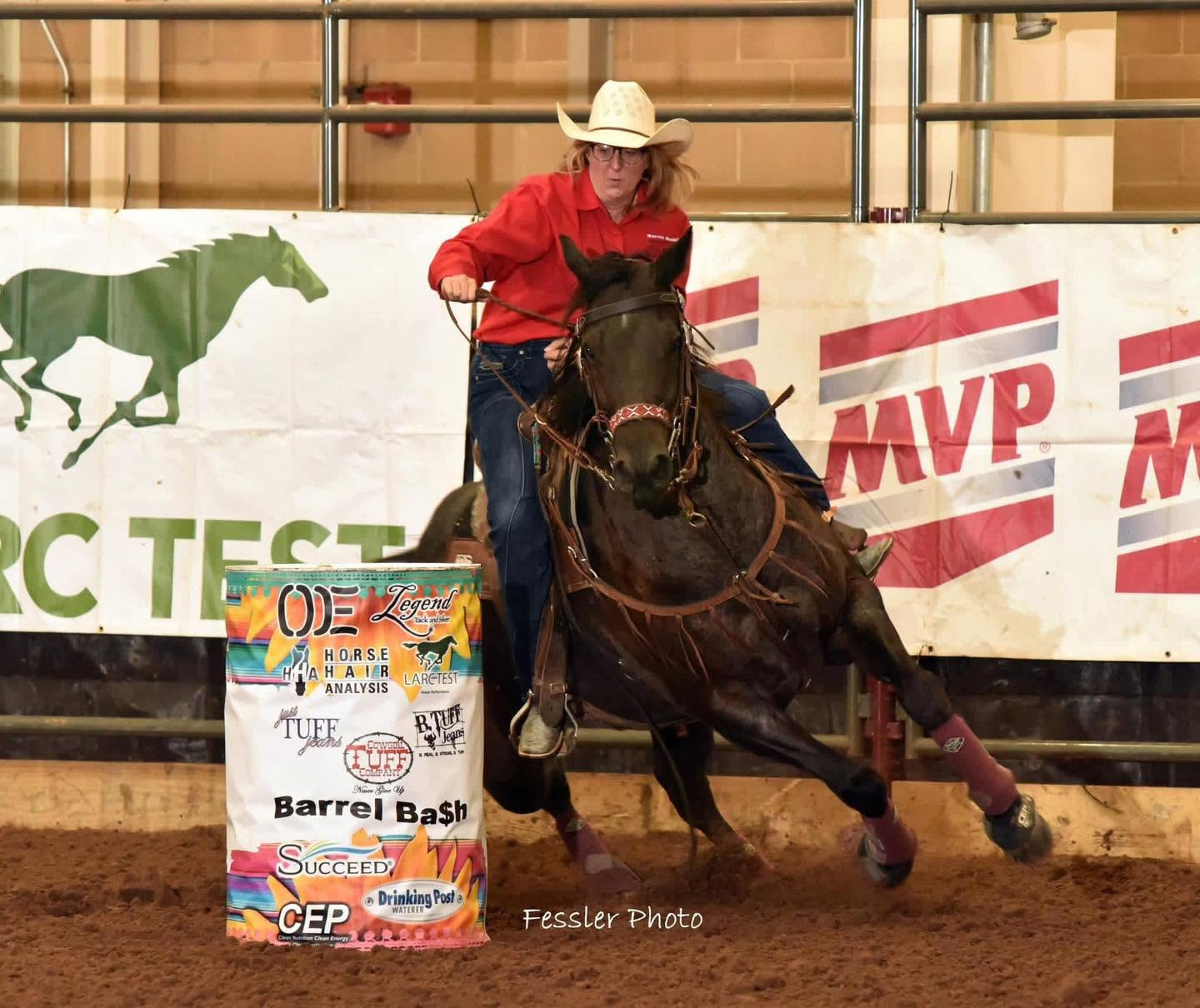
Renea Bolling produces the Barrel Bash tour and the Bonus Race World Finals through Double B Productions, and she has been doing it full time since she quit a job in Des Moines, Iowa, to plan barrel races. She joined Kayla Jones on The Money Barrel to open the cost sheet on an open race, walk through the two facilities that cost her a finals and explain the night she stopped her own race because the ground went to concrete.
Table of contents
Who is Renea Bolling?
Bolling grew up in Iowa in a family that showed Quarter Horses and rodeoed. She hauled to Bob Barnes rodeos with her sister and brother-in-law, a PRCA rodeo clown, and washed horses for the grand entry. She got a hand-me-down horse in 1980, when she was 10, and started to the amateur rodeos the next year. She rodeoed in high school and college. Her production start was on the roping side, running her family’s ropings in the 1990s on an envelope system with everything done on paper. She moved to Oklahoma in 2011.
“I don’t think I’m ever going to be able to retire. You’re just going to have to kill me off or something.”
Bolling on getting out. Events pay into her finals a year ahead, which she said makes walking away close to impossible without selling it or handing it off.
How Barrel Bash started
The idea came on an hour commute to Des Moines. Bolling spent almost a year promoting one race at Fremont, Nebraska, capped at 300 entries, with seven saddles, better than 30 buckles and prizes down through every check. Entries came in by mail. It filled. She ran three races in 2000, added another the next year and then left her job. She put the added money at $5,000 or $7,000, about what it is now, and said sponsors were easier to get because nobody else in that part of the country was putting on events.
“I know people don’t believe me when I say this, but this was never like, ‘Oh, this is going to be my job or doing it for the money.’”
Bolling on why she started producing. She said planning events, chasing sponsors and watching somebody win a first saddle is what gives her a high.
Why BBR was formed
Before Better Barrel Races there was the Alliance of Barrel Racing Producers, a group of production companies and associations that Bolling said came together to honor each other’s bad-check lists. She said that turned out not to be legal and the group disbanded. Some of the same people then formed BBR. Bolling was a founding member and said Angie Clark of Heartland Tour brought her in for her northern contacts. Among the others she named Robin Hoffman, Buzz Post, and Chuck and Phil with D&G. The purpose, as she describes it, was standards: payout percentages, added money and how races were advertised, after events promoted a $50,000 payout in wording that read like $50,000 added. She put her exit from BBR at 2010.
“Let’s do better. Let’s find a way to make this so that these things aren’t happening, that people know when they go to a BBR event that there’s a certain standard that’s being met.”
Bolling on what the founding producers were after. She said the group started with no sponsors beyond the trade show.
Why the Bonus Race World Finals moved to Shawnee
Bolling started the finals at Lincoln, Nebraska, a year or two after leaving BBR, running two arenas at once and putting up 600 or 700 stalls. Two horses that had been at her event died of equine herpesvirus, and she said the facility pushed her out because the Quarter Horse show that followed did not want to come in behind barrel racers. She moved it to Tulsa, Oklahoma, where the COVID-19 shutdown hit, and after that year the fairgrounds told her it had no date for her. Tulsa found a way to take her back, in the pavilion, where she had been shown 3 feet of dirt over an electrical box and arrived to find the outlet visible. Her crew probed the ground all week. They hit concrete and she stopped the race. The finals moved to Shawnee, Oklahoma, the next year. Tents went up, one fell down before the race and more than 300 stalls were still unbuilt the Monday people started arriving. Bolling hired her own crew and went to the city for help.
“I’m a control freak and it was literally out of my control and I literally just had to take control of it.”
Bolling on the first Shawnee year, which she puts in her top three worst. She said Chuck and Marilyn Jones got her through the week.
What it costs to produce an open barrel race
Barrel setters run $20 an hour and Bolling staffs three, plus one or two tractor drivers, fuel to get the crew there and hotels. Stalls are contracted for the weekend rather than by the night, and she pays for what she guarantees whether it sells or not. Going into her Barrel Bash stop at Springfield, Missouri, she had 163 entries at the deadline and had the facility set up 190 stalls. She said office fees have not changed in the time she has been producing while every other cost has, and that she is making changes in the next year.
“Nobody that’s doing the amount of events I am has all their added money covered.”
Bolling on the math behind an open race. She said a Tuesday night jackpot in town charges the same office fee her events do.
Why Barrel Bash added breakaway
Breakaway went in at the finals the year the barrel race came back off the two-arena format, and Bolling said it does not make money. The breakaway has drawn about 450 entries. Her husband asks why they keep it. Her answer is that breakaway ropers have almost nowhere to go in the summer and that calves are expensive enough to keep producers out of it. She also said a girl starting out ought to be able to win big money somewhere other than an open rope.
“I don’t feel like I’ve ever catered really just to the high end of people or to the trainers or the professional level.”
Bolling on who her events are for. She said she has tried to give people starting out a big event to go to and somewhere to win big money.
Inside the episode
- How she got into producing on the team roping side
- Running ropings on an envelope system before laptops
- The performance horse sale at Fremont she would not do again
- Why she will never own another indoor arena
- How incentive money decides which events draw now
- Her gate rule, and why the gate does not reopen mid-run
- Keeping stall, office and entry fees the same across the tour
- Why she started doing Facebook Lives
Listen
Members get almost 15 extra minutes with Bolling at patreon.com/themoneybarrel, $5 a month, the cost of a single exhibition. The bonus segment covers what competitors need to know, what producers need to know and ground at different arenas. Subscribers also get a bonus episode later this week with Tana Renick.
Sponsor — Chewy
This week’s episode is brought to you by Chewy. Don’t let an empty bottle or supplement tub interrupt your end of summer riding goals. Chewy makes it easy to stock up on electrolytes, fly protection, hoof care, first aid and supplements from brands horse owners trust.