

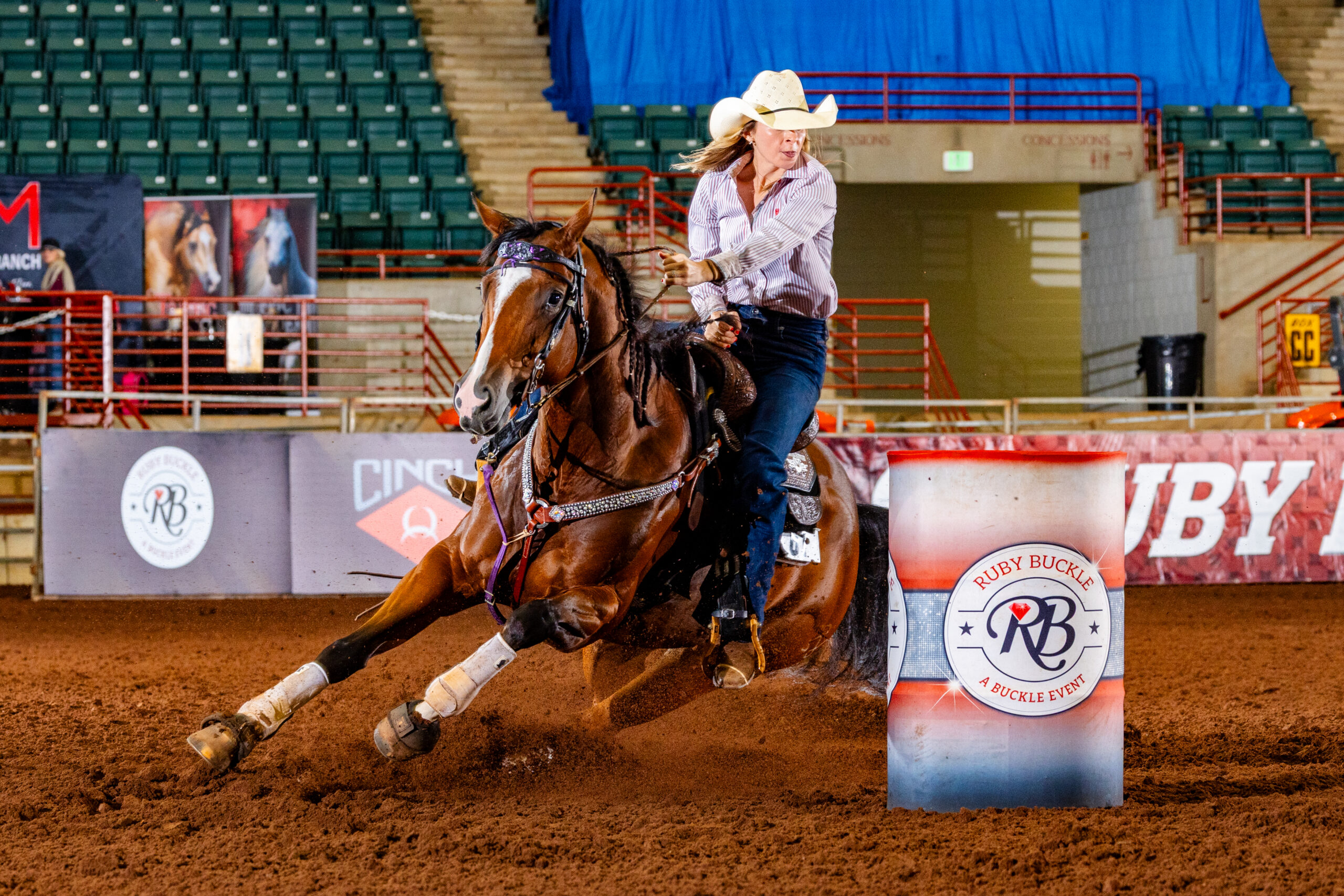
Blaise Wheeler won the Ruby Buckle East derby average aboard Gimme All DaMoney in Perry, Georgia, banking $31,515 across the week for owners Jason and Leslie Willis of Chester, South Carolina, on a horse she had been riding for one month.
Wheeler, of Summit, Mississippi, won the first round on the 2021 Tres Seis gelding for $6,250, came back 1D-11 in the second round for $525, then locked up the average in 29.810 for another $12,500. Lilli Hayes was second in 29.860 on KB Tres Times French for $8,500 and Taylor Langdon third in 29.861 on Hes Got The Sting for $6,500, a thousandth apart. Both runs rolled into the Open, where he was 1D-2 in the first go for $4,080 and 1D-2 in the average for $8,160, .076 behind futurity champion SS I Am Misty.
The derby was her sixth and seventh rides on the horse.
“The goal was to get a good first barrel, as always,” Wheeler said, walking through the opening round. “And I think he saved me on the second, because I think we were going to hit it and he kind of bowed out. So we were out in the middle, and I was just thankful to get by that third. And he’s fast.”
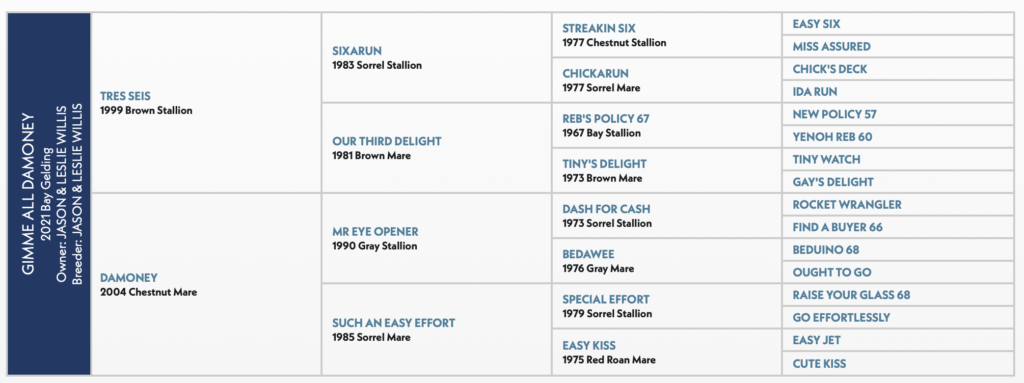
Gimme All DaMoney (Tres Seis x Damoney x Mr Eye Opener) is owned and bred by the Willises, and Leslie Willis trained him herself. She was hurt last year in the middle of his futurity year, and the accident left her paralyzed from the waist down and no longer training.
Brett Monroe finished the futurity year on him, after some persuading.
“I had to make Brett promise me that he would take him to five different shows and cross the Mississippi five different times,” Willis said. “And it took him two weeks to say he would even take my horses.”
At the end of that futurity year Willis dispersed her derby horses to riders she picked. Gimme All DaMoney went to Brian Wheeler. The mare Felice Seis went to Brian’s wife, Blaise. Then Brian got bucked off and broke his collarbone.
“At first he was Brian’s and I got Felice Seis, and Brian broke his collarbone,” Wheeler said. “And so his horses became my horses, and here we are.”
Willis made the call.
“I called Blaise and I said, do you want to try to ride him? And she said, sure,” Willis said.
The brothers
He exists because Willis went looking for a copy of one she already had. She rode his full brother, Gimme Da Money, to become a decorated futurity, open and incentive champion. Then Jason Willis bought his dam, DaMoney.
“I said, well, the best thing to breed it to is Tres Seis again. So they’re 11 years apart,” Willis said, outlining the plan behind a pair of full siblings foaled more than a decade apart.
The older horse’s barn name is Trouble. The younger one got Little T, for Little Trouble.
“I didn’t want to call him Trouble, just because I didn’t want him to be a lot of trouble,” Willis said. “So unfortunately, sometimes he can be a little bit of trouble.”
The copy did not come out identical, and a training part of that was on purpose. Trouble was stiff through his turns and wanted to come around before he got there, the kind of horse who takes the barrel away from you. When the younger full brother came along, Willis’s worry was that he would do the same thing, so she trained him not to.
“I was scared when I trained him. I said ‘Oh my gosh, don’t teach him to turn the barrel,’ because of how his full brother was,” she recalled. We really need to make him learn to go around the turn. And if he ever cut me off, he got scolded for it as a baby. So that may be why he doesn’t turn it like his big brother.”
It took. Where Trouble wanted to turn early, this one runs true.
“He waits on you,” she said. “He almost waits on you too much.”
That is the horse Wheeler was handed, and squaring him up was most of what she changed.
“He’s all bendy in the middle everywhere. So we’ve tried to do squares on him instead of a circle, and square him up, and it’s helped get closer to the barrels,” Wheeler said.
Do your homework
The first outings were not what anybody wanted. Wheeler ran him at two jackpots and the horse looked like a zigzag. Willis’s diagnosis was blunt.
“He’s got a baby brain. That’s the best way to describe it. He’s a derby horse that needs to be treated like a futurity horse,” Willis said. “So I always tell her, go do your homework at home. Go through the pattern at home in the same tracks you want him to run in.”
Wheeler did the homework. The weekend before Perry she made three runs in a row at Jackson, Mississippi.
“I’ve gone to two jackpots, and last weekend we went to Jackson and made three runs in a row,” Wheeler said. “We had a good weekend, three consistent runs.”
Willis pointed to that weekend as the hinge.
“I think that gave her the confidence to come here, because the first couple runs were not what we were wanting,” she said. “So it’s like driving a new car. You got to learn the buttons, and they have to learn you.”
None of it happened without a phone.
“I call her and I question her about things. What do I need to do? Where do I need to go? What do I need to fix?” Wheeler said. “And she’s a lot of help.”
Wheeler called before the exhibition at Perry to ask what to do with it.
“She said, I have one exhibition. What do I need to do? I said, well, don’t run him, but don’t lope through there either,” Willis said. “Just cruise him through and make him do it right. So that’s what she did, and it’s all paid off.”
The homework did not stop when the horse started winning. After Jackson, Willis told her to give him a day off and then go home and treat him like he hadn’t done a thing.
“We don’t work him hard, but it’s a matter of loping through the pattern and putting his feet in the right spot,” Willis said. “And it’s worked.”
She put the credit where she thought it belonged.
“I appreciate Blaise for doing all the work and putting in all the homework and listening and calling.”
‘Just’ Under 15
The announcer told the pen what the second round would take to win the average, and Wheeler heard it on her way in. She needed a 15.01.
“I don’t remember much about the run, but when we came out and he said a nine, I didn’t even worry about the rest,” Wheeler said. “I was pumped up.”
She ran 14.966. It was not her prettiest trip and she said so.
“We had a little bobble here and there, mistakes. It wasn’t perfect, but it was good enough and I’ll take it,” Wheeler said. “I just kept thinking, keep going forward. You got enough horsepower.”
Willis was doing the same math from the rail.
“Some of the mistakes he made today, at least he’s fast. You can’t substitute for speed,” she said. “So he did have some mistakes, but we still stopped the clock where we needed it to.”
The first barrel at Perry
Perry brings you to the first barrel out of a corner, which Willis will tell you plainly is close to blind. Wheeler doesn’t take it that way. She hauls to the back wall, turns around and comes up the alleyway straight, because that is how she trains and how her home shows are set up.
“When I come around the corner, some people lope to start to the first barrel. I get way too far out there,” Wheeler said. “If I go back there and turn around, because we run most of our shows, we come from the back. So I’m just used to coming from straights. For some reason it helps me.”
Willis backed the choice and broke down the physics of it.
“When you come out of that corner you can get too far out into the middle of the pen. Or if you hook the corner too close, you can be too straight at it,” she said. “Where when she goes back, she can get a more medium approach coming up the middle of the alleyway and hold them in that straight line. Where when they come out of that hook, you’ve got this zigzag.”
Then she went broader.
“It depends on what you’re used to training. If you’re used to coming out of a circle, this is a perfect setup. If you’re used to coming from the back gate, then go back to the back and do what’s comfortable for you,” Willis said. “And so many people get to big shows like this and they want to do what everybody else is doing, when they don’t do what’s comfortable for them.”
Wheeler learned to read a blind first barrel as a kid, on foot, from Barbara Estep.
“Every barrel race we went to, she would make me walk down the alleyway and find a spot to look at. If you couldn’t see the first barrel, it was blind,” Wheeler said. “She would make me find a spot at the other end of the arena to aim for. I still do that. We would walk in there, she would go out to where the barrel would be, and we would step it off and find something to look at.”
Willis preaches the same thing in her clinics. Don’t look at your first barrel, she tells them, find a spot and run to that spot, and where the spot sits depends on the horse.
For this horse at this barrel, Wheeler called to get it exact, and the answer went back to the way Willis trained him to wait.
“He needs a little bit of a bigger pocket than you think. And don’t leave the alleyway wide, leave the alleyway in your line,” Willis said. “But when you get to that pocket, just let him stay out there just one stride longer. And then he sees it and he can turn it tight and leave it straight.”
She nailed it that morning, Willis noted, in the run that won the round.
Matching winners with winners
Willis has spent the past year turning a training career into an owner’s program, and what she matches on is style. The contrast between the two horses she sent Wheeler is the clearest example she gives.
“The first derby horse I sent her has a real stiff style, and a very forgiving horse. You can put her in the wrong spot and she’ll put herself in the right spot,” Willis said, comparing Felice Seis to Gimme All DaMoney. “This one is very noodly. And if you put him in the wrong spot, he does it, but he doesn’t do it very well. So you really got to be spot on with this horse.”
The theory underneath the matching is the mare.
“To me, I’ve always said that mare’s 85% of it, unless you have a really, really strong stallion. Like Dash Ta Fame and Tres Seis. They really stamp those horses,” Willis said, describing a sire’s signature as something you can spot from across a barn. “If a Dash Ta Fame walked down the hallway, you knew it was a Dash Ta Fame. The Tres Seises, they’re different colors, but if you look at their legs and their conformation, they’re all lean.”
The stamp goes past the legs. Felice Seis and Gimme All DaMoney are both small-barreled, which Willis says runs through most of her Tres Seises. One mare breaks the pattern.
“Now Jess Genesis One is a Tres Seis and she’s a big-barreled mare,” Willis said. “She’s just an exception to my Tres Seises.”
Four of the six head the Willises entered at Perry are by Tres Seis, and two of them, Gimme All DaMoney and Jess Genesis One, are Tres Seis out of Mr Eye Opener mares. Tres Seis sired both the derby champion and the reserve champion, and by the time the Open average was posted he had 1D-2, 1D-3 and 1D-4 in it.
Where a cross is working, Willis leaves it alone.
“If you have a jockey that’s riding babies out of that mare and they’re doing good, for sure don’t change it,” she said.
Where it isn’t proven, she runs the test. She has put horses in Jordan Harrell’s hands and intends to send her the half siblings to find out whether the mare suits the rider before she commits the next one.
“Did this mare suit this jockey? And if it didn’t, then I’m going to try something else,” Willis said.
The next crop will test the method harder, because Willis has never been on any of them.
“This group, the derby horses and the futurity horses that are running right now, I rode and trained. So I really can tell my jockeys this is what they need, this is how I did it,” she said. “The next group, they’re kind of on their own. They were 2-year-olds and they just had came in the weekend I got hurt, from my colt breaker. So I haven’t got to sit on them.”
Perry, one year on
Both women have history in this building. Wheeler won the Open first round here last year on SBW Copy Cat, and the same 2016 Blazin Jetolena gelding paid her $4,456 this week across the Open first go and the owner/rider sidepot. He is a horse she owns, bred by her mother-in-law, Stephanie Wheeler of Hattiesburg, Mississippi. Two more she owns cashed in the Open average, Back That Peach Up for $2,784 and BR Shot For Shot for $3,600, putting her own horses at $10,840 for the week on top of what she won riding for the Willises.
“We love Perry. I love this arena. I don’t know why it fits me,” Wheeler said. “I seem to always have good luck here, and I’m very thankful for that, because a lot of big shows are here.”
For Willis, last year’s Ruby Buckle East was the first show she got to after the accident, and she got there out of rehab on sheer insistence.
“Last year I was in rehab and I told him, I said, I’m going to this horse show. I don’t know what strings we got to pull, but we’re going to go to this horse show,” she said. “So this was the first outing after my accident, and it was pretty emotional.”
This year the rest of her program filled out the sheets around her. Jordan Harrell won the futurity second round on OE Bachelor Pad for $8,000, a run that happened in real time behind the interview set, then took the futurity average 1D-4 for $7,600 and rolled the same runs into the Open for another $5,808, finishing the week at $22,008. Ceri Ward placed Jess Genesis One 1D-6 in the derby second round for $1,450, 1D-15 in the derby average for $750 and 1D-11 in the Open second round for $504. Across six head the Willises left Perry with $56,227 in owner money, plus $3,940 as breeders of Gimme All DaMoney. Their horses generated $7,029 in stallion incentive, $4,278 of it to Tres Seis.
“He had some bad luck yesterday, but came back today and made everybody proud,” Willis said of the blue roan, who won the slot race at the BFA earlier this year.
Willis thanked her sponsors, Advanced Equine Nutrition and Cox Veterinary Lab.
Willis credited all of her jockeys, and pointed out that it’s as much of the work outside the arena that makes her place horses with them, not just inside.
“Blaise works hard at home. Yes, she’s had great horses, but great horses can go in the wrong hands and they don’t stay winners,” Willis said. “Her work ethic at home and her work ethic out here, wrapping legs, hosing horses off, making sure they’re comfortable. That’s why she has my horses. And that’s why the jockeys that have my horses have my horses, because they take care of them.”
Ask the question
Wheeler isn’t scared to ask and adapt her style in order to win on a horse.
It is not a habit she picked up for this horse. When Plea Bargain, a horse she got out of Carlos Renato’s program, wasn’t coming together after three or four months of working at it alone, she quit working at it alone.
“Finally I told Brian, we’re going to Texas. I got to see how he does it,” Wheeler said. “Trainers know a lot about those horses. Ask.”
Next is the Breeders Challenge, and the assignment has not changed.
“We got to go home and keep doing the homework,” Wheeler said.
Asked what she would tell somebody trying to get better, she did not reach for a drill.
“Ask them, what did they do? How did they do it? How can I be better? Even if it is a good run, sometimes I’m still asking, how can I be better? What can I do different?” she said. “Ask the question. It never hurts. More than likely nobody’s going to tell you no. They’re going to help.”
For full results, visit rubybuckle.com.