


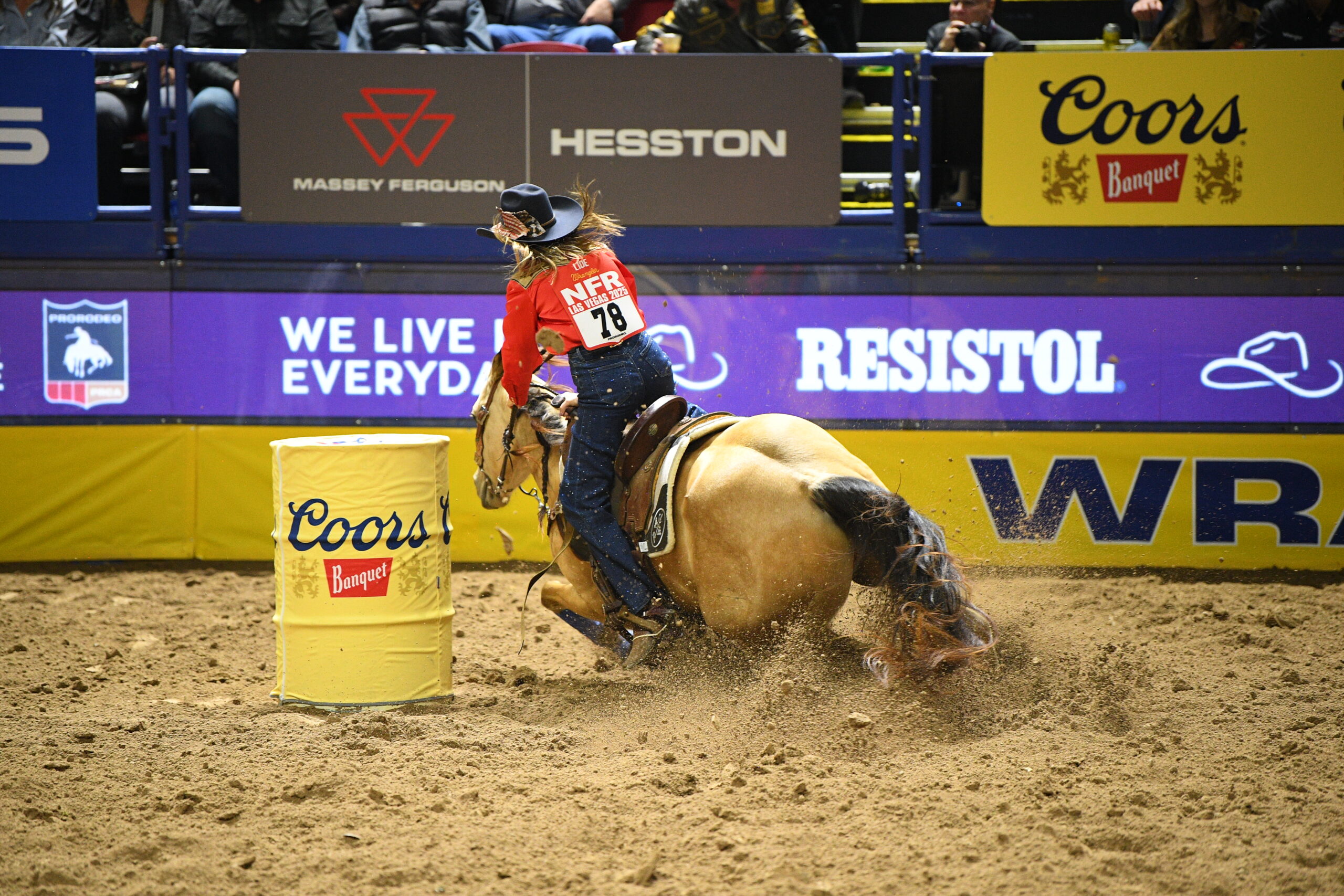
After six nights of consistent footing inside the Thomas & Mack Center, the ground took a visible turn in Rounds 7 and 8, raising concerns among contestants and drawing attention to the most high-stakes playing surface in rodeo.
Several horses slipped or lost traction on Wednesday and Thursday, prompting immediate response from the WPRA and the NFR ground crew led by Randy Spraggins, Ricky Hibbeler, and general manager Allen Rheinheimer.
While social media speculated, the people closest to the issue — competitors, the WPRA, and the dirt team responsible for the arena — emphasized two truths: the ground changed suddenly, and the crew responded aggressively to fix it.
“We’ve thrown everything but the kitchen sink at it at this point. We’ve got the best crew in the industry on this, and they were perplexed.”
Heidi Uecker-Schmidt, WPRA President
Early Week
From Rounds 1–6, the footing drew almost unanimous praise from barrel racers. WPRA President Heidi Uecker-Schmidt, who watches the ground daily and communicates directly with all 15 athletes, said feedback in the early rounds was strong.
After Round 6, she noted that there were “no comments except applause” from the group text she shares with the barrel racers. Everything pointed toward another year of consistent, reliable footing.
The Shift After Round 6: “It Went Downhill”
But following Round 7, Heidi says the footing “went downhill” quickly. The change wasn’t subtle — multiple horses struggled to stay upright, and visible slip patterns appeared at both the right and left barrels. She emphasized that the concern wasn’t rider error or isolated mistakes. It was the ground itself.
Even Randy Spraggins acknowledged confusion, telling Heidi late Thursday night after Round 8, “I’m at a loss,” before he hit the drawing board.
With two of the nation’s most respected ground specialists perplexed, the WPRA and NFR leadership initiated immediate action.
All-Night Reset: What the Crew Changed
Heidi confirmed that after Round 8, the dirt team performed a complete arena reset, something that had not occurred earlier in the week.
This reset included:
- Regrading the entire arena
- Ripping to the bottom
- Rebuilding the composition from the base up
- Rewatering and resting the ground overnight
Dec. 12’s practice prior to Round 9 showed an immense improvement.
“It definitely looked different… more firm… it held together. Any of the horses that tried it stood up without a problem,” Schmidt said.
Why Did It Change?
The dirt composition is screened and adjusted each year, but what the crew experienced in Rounds 7 and 8 was unusual. Heidi emphasized that the material may be behaving differently than expected. Even with 13 moisture sensors and regular probing for hardpan, she said:
“It didn’t stay like it was in Round 6. I don’t know what it is about the building itself… it does change.”
Randy Spraggins and and Ricky Hibbeler highlighted challenges unique to the Thomas & Mack:
- Different events require different footing: bareback and saddle bronc horses need “bounce,” while timed-event horses need grip.
- The small arena size makes even a tiny section of problematic dirt enough to impact a run.
- The ground is worked differently in specific sections to cater to roughstock or roping events, meaning a failure in one part affects only certain areas.
This is not simply “dirt.” It is a carefully engineered, highly sensitive performance surface for multiple disciplines.
What the Crew Felt: “Randy’s About to Have a Heart Attack”
One misconception circulating online is that the ground crew might be indifferent to barrel racing outcomes. Heidi strongly rejected that idea:
“Are they standing in there just laughing or ignoring it when the barrel racers fall? Oh my God, no. I think Randy’s about to have a heart attack.”
Heidi Uecker-Schmidt
While barrel racers were already flooding social media with negative comments about the dirt after Round 8, Schmidt was tracking the conversation in a massive production meeting that stretched late into the night inside the Thomas & Mack.
“They got together specifically to talk about the footing last night, immediately after the round,” Schmidt said. “Then, it was an all-night project to work on that ground.”
What’s Next: Sustaining It Through Round 10
Alan, Randy, and Ricky have:
- Adjusted tools used to prep the ground
- Adjusted moisture
- Fully rebuilt the arena once
- Increased monitoring
- Coordinated closely with the WPRA on feedback
- Stayed in near-constant communication behind the scenes
Schmidt also reiterated that drag before the barrel racing begins, and halfway in-between is something the WPRA is still fighting for in Las Vegas, but for this specific issue, it wasn’t going to solve the core problem.
Bottom Line: Here’s What Actually Happened
No one minimized the seriousness of the footing changes. But no one — not the WPRA, not the riders, not the ground crew — suggested it stemmed from lack of effort.
Everyone is rowing in the same direction to ensure the final two rounds are safe, fair, and worthy for the top 15 barrel racers in the world.