


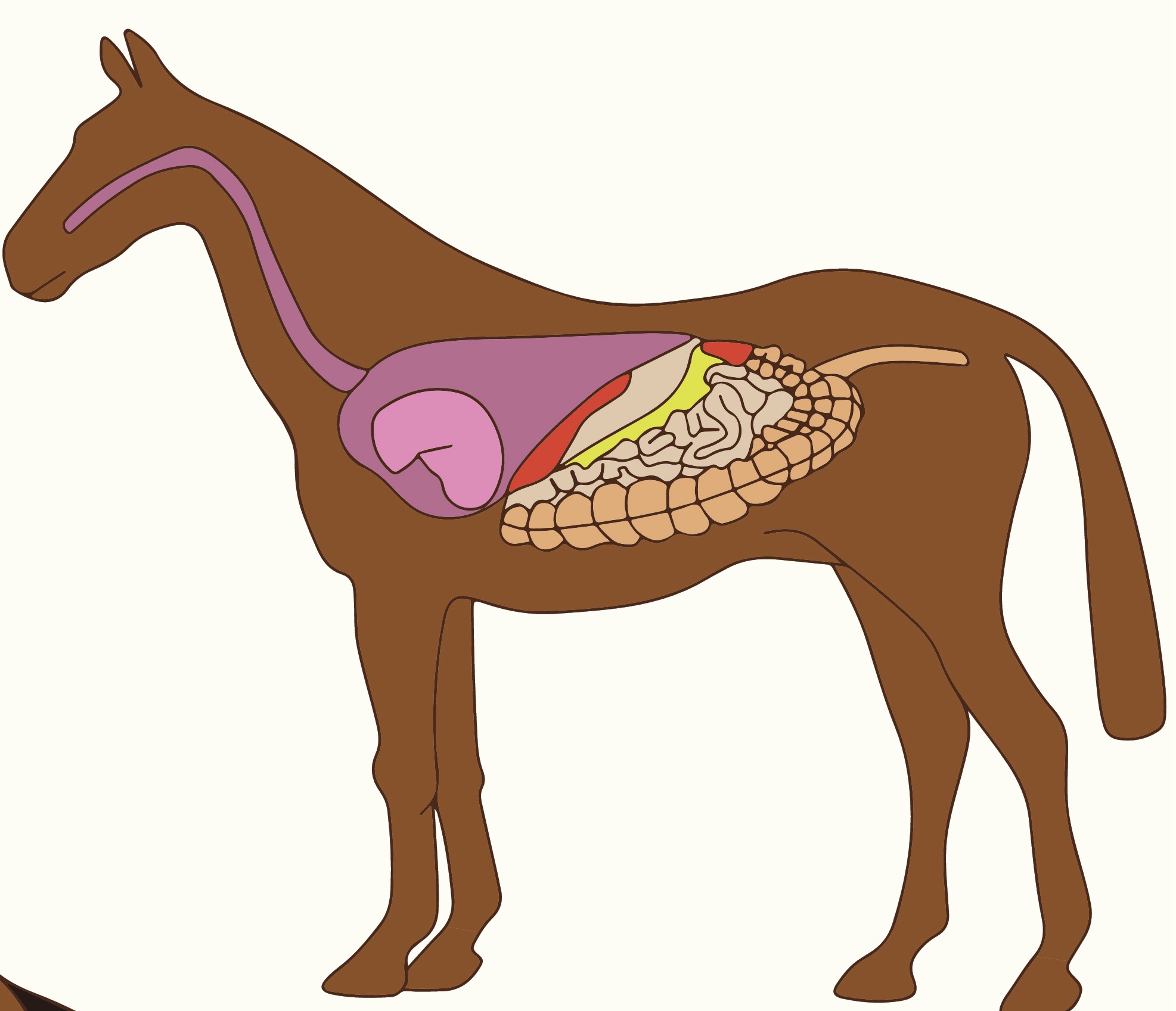
If you want to be a well-informed barrel racer, understanding the way a horse’s digestive system works from the time food goes into their mouth, to the time it is excreted out of the other end is essential to being a well-informed horse buyer and consumer.
Let’s arm you with some equine anatomical knowledge.
Mouth
- Chewing: Horses use their teeth to grind food into smaller particles. Adequate chewing is essential to prevent choke and aid in digestion.
- Saliva: Saliva moistens the food and begins breaking down carbohydrates with enzymes. Insufficient saliva production can lead to dry feed and choke.
Esophagus
- Transport: The esophagus is a muscular tube that transports chewed food from the mouth to the stomach through peristalsis (wave-like muscle contractions). Problems here can include choke, where food becomes lodged in the esophagus.
- Stomach:
- Initial Digestion: The stomach holds about 2-4 gallons, requiring horses to eat small, frequent meals. Gastric juices containing hydrochloric acid and pepsin begin protein digestion. Ulcers are a common issue due to prolonged acid exposure, often from irregular feeding schedules or high-grain diets.
Small Intestine
- Primary Digestion and Absorption: Spanning about 70 feet, the small intestine consists of the duodenum, jejunum, and ileum. Here, enzymes from the pancreas and bile from the liver help break down proteins, fats, and carbohydrates. Nutrients, including vitamins and minerals, are absorbed. Blockages or malabsorption can lead to colic or nutrient deficiencies.
- Cecum:
- Fermentation: Located at the junction of the small and large intestines, the cecum acts as a fermentation vat, holding up to 8 gallons. Microbes break down fibrous plant material, producing volatile fatty acids (VFAs), a primary energy source for the horse. Imbalances in microbial populations can lead to colic or laminitis.
Large Intestine
- Further Fermentation and Water Absorption: This section includes the large colon, small colon, and rectum. Further fermentation of fibrous materials occurs here, with absorption of water, electrolytes, and VFAs. The formation of feces takes place before expulsion through the rectum. Issues such as impaction, gas build-up, and torsion can cause colic.
Liver
- Bile Production: The liver produces bile continuously, which is secreted into the small intestine to aid in fat digestion. Unlike many animals, horses lack a gallbladder to store bile.
- Pancreas:
- Digestive Enzymes: The pancreas produces enzymes and bicarbonate, secreted into the small intestine to help break down carbohydrates, proteins, and fats.
- Nutrient Absorption:
- Process: Most nutrient absorption occurs in the small intestine, while the large intestine absorbs water and VFAs produced by microbial fermentation. Inadequate absorption can result in weight loss and poor health.
Isolating digestive problems
- Choke: Caused by food lodging in the esophagus, often due to insufficient chewing or dry feed.
- Ulcers: Resulting from prolonged exposure to stomach acid, often due to irregular feeding or high-grain diets.
- Colic: Can arise from various issues, including blockages, gas build-up, or torsion in the intestines.
- Laminitis: Often linked to imbalances in the cecum’s microbial population, particularly from rapid changes in diet or high sugar/starch intake.
- Malabsorption: Issues in the small intestine can lead to nutrient deficiencies and weight loss.
More health resources
- Why Hauling Is Hard on Horses’ Gut Health
- 🧂Talk Salty to Me: Understanding Electrolytes for Horses🧂
- Here’s How to Keep Stallions Happy—and No, It’s Not What You Think.
- How to Know if Colic Surgery is Worth it
-
2025 NFR Barrel Racing Results, World Standings Updates
The 2025 NFR is underway, and we’re keeping up with all of the round-by-round results, story links and World Standings updates in the barrel racing. Results Round 9 Payout 1 Carlee Otero 13.2 $36,667.95 2 Hayle Gibson-Stillwell 13.43 $28,979.51 3 Lisa Lockhart 13.54 $21,882.48 4 Emily Beisel 13.55 $15,376.88 5 Tricia Aldridge 13.69 $9,462.70 6…
-
What’s the Deal? The Real Dirt on the NFR Footing
After six nights of consistent footing inside the Thomas & Mack Center, the ground took a visible turn in Rounds 7 and 8, raising concerns among contestants and drawing attention to the most high-stakes playing surface in rodeo. Several horses slipped or lost traction on Wednesday and Thursday, prompting immediate response from the WPRA and the…
-
All Aboard the “Chewy” Train: Rounds 1-9 NFR Barrel Racing Horse List
The official word is in from the Women’s Professional Rodeo Association, and here’s the horses the barrel racers are choosing daily to ride inside the Thomas & Mack. Round 1 Round 1 Round 2 Round 3 Round 4 Round 5 Round 6 Round 7 Round 8 Round 9 Kassie Mowry CP He Will Be Epic…